Defining settlement rules
All settlement rules contain the same types of criteria. How you define them depends on whether you are applying them to the client, agency, or a user. You must define at least one agency or one client settlement rule before the system will allow a user to create a settlement plan. If a client has additional rules they want enforced, you can enter those rules as well, but client-level rules are not required to create a settlement plan. For more information, see Creating or changing agency settlement rules.
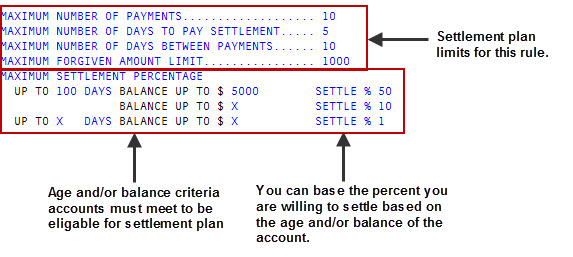
Settlement rules contain criteria that fall into two areas: settlement plan limits and account balance criteria.
The first part of each settlement rule contains criteria related to limitations of the type of plan a collector can create. This criteria dictates the maximum number of payments, number of days in which the settlement must be paid, number of days between payments, and the forgiven amount limit.
The second part of the settlement rule dictates the maximum settlement percentage a collector can settle for. This percentage is determined by the age of the account and/or the balance of the account. For each settlement rule, your agency decides the amount it is willing to settle for based on the age of the account and the balance on the account.
Consider the example of a fictitious agency, Lake Assets, that allows their collectors to offer settlements, as follows:
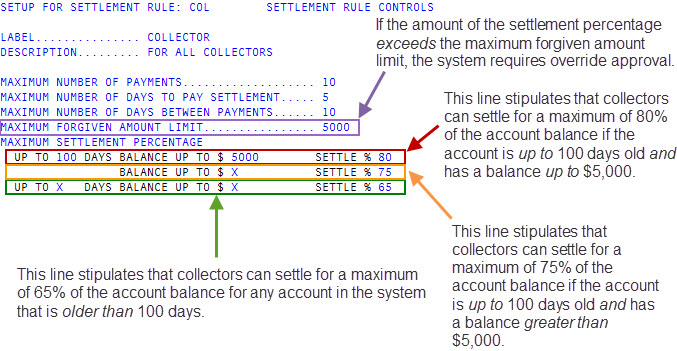
- If the account is less than 100 days old and has a balance of less than $5,000, collectors can settle for 80% of the account balance.
- If an account is less than 100 days old and has a balance of more than $5,000, collectors can settle for 75% of the account balance.
- If an account is more than 100 days old—regardless of the balance—collectors can settle for 65% of the account balance.
In this example, Lake Assets creates the rule as shown below.
When an account meets the settlement rule criteria, and if the user has the proper authorization level, the collector can create a settlement plan.
In some situations, you may or may not want to configure settlement rules, depending on the following:
- If all of your clients do not allow settlement, do one of the following:
- Do not create agency settlement rules. If the client settlement table does not exist, a message displays, and the user cannot create a settlement for the applicable account.
- Configure the agency settlement rule to require 100% repayment of debts.
- If the client allows settlements, but does not specify settlement criteria or limits, then create an agency settlement rule that users can override, if needed.